


Plantcompass
Amaranth family (Amaranthaceae)
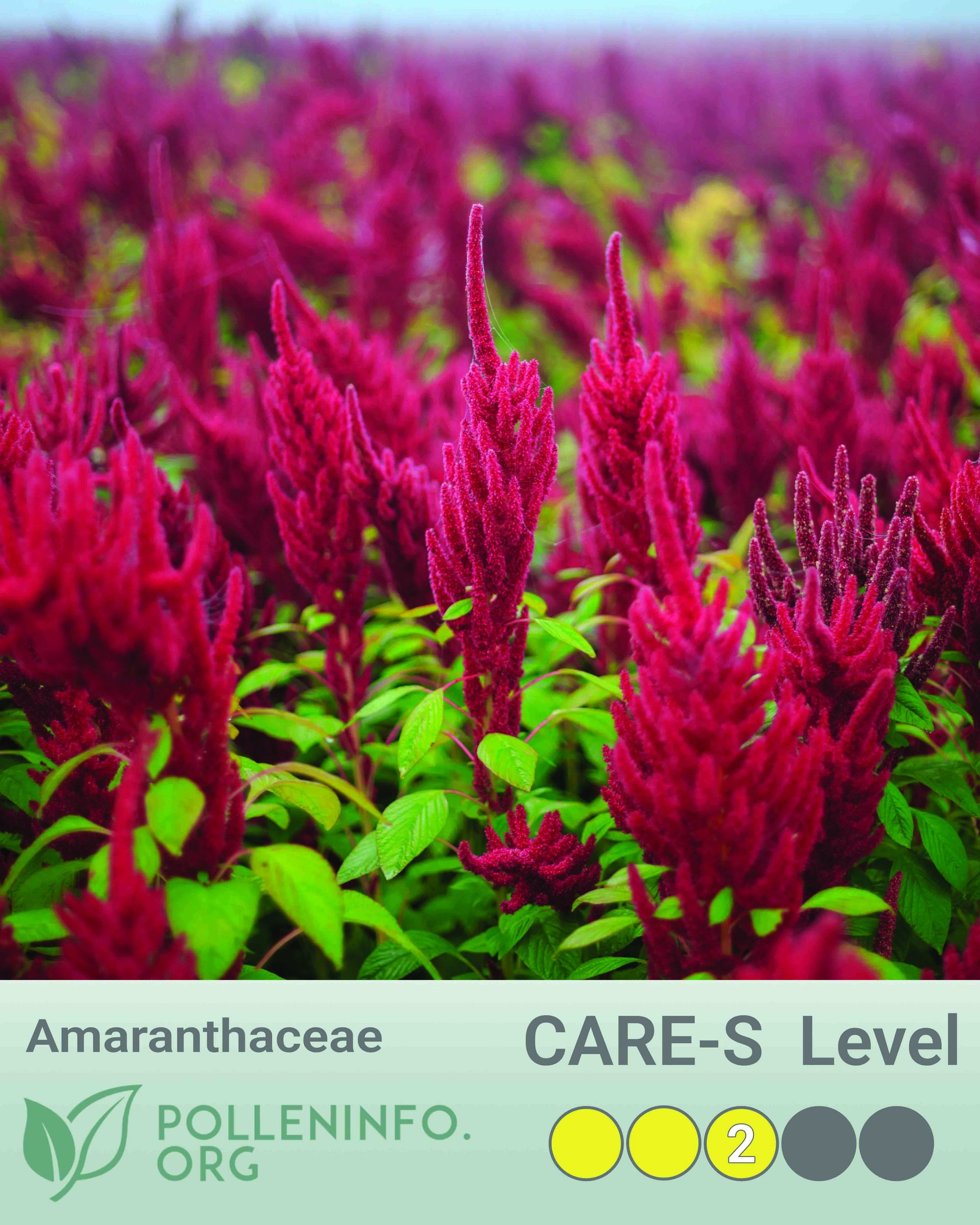
General Information
Family: Amaranth family (Amaranthaceae)
Flowering period in Central Europe: Full spring to autumn
Months: (4)5–9(10)
Allergy potential
CARE-S* Level 2.
Cross-reactions
Various allergens have been identified within the amaranth family. Due to the structural similarity of these proteins, cross-reactions can occur within the family.
Botanical Information
Distribution
There are between 2,050 and 2,500 species of amaranths worldwide, found on every continent except Antarctica.
Commonly occurring species in Europe
Amaranth (Amaranthus spp.).
Allergy potential — CARE-S* Level 2 (allergen Ama r1). Habit — Herbaceous, mostly annual, rarely perennial. Foliage — Leaves with entire margins and often rhombic in shape. Reproduction — Wind-pollinated, terminal simple or panicle-like pseudo-spikes; some species (e.g., red amaranth) are cultivated as grains for their seeds, while others (e.g., weeping amaranth) are popular as ornamental plants due to their strikingly colored inflorescences. Habitats — Disturbed sites, fields, gardens, and parks. Flowering in Central Europe — Late June to late September.
Goosefoot (Chenopodium spp.).
Allergy potential — CARE-S* Level 2 (allergen Che a1). Habit — Herbaceous, annual or perennial. Foliage — Young leaves often covered with spherical vesicular hairs; leaves toothed, resembling a goose’s foot (name). Reproduction — Wind-pollinated; flowers in corymb-like inflorescences arranged in panicle-like to pseudo-spike inflorescences; the seeds of quinoa (Chenopodium quinoa) are used as a grain. Habitats — Disturbed sites, fields, gardens, and saline soils (salt-tolerant species). Flowering in Central Europe — late April to late September.
Saltwort or tumbleweed (Salsola spp.).
Allergy potential — CARE-S* Level 2 (allergen Sal k1). Habit — Herbaceous, annual. Foliage — Leaves mostly fleshy, alternate, sessile, with spiny tips. Reproduction — Wind-pollinated, inconspicuous flowers occurring singly in the axils of the bracts. Habitat — Rare in eastern Austria, found on sandy and gravelly sites and sandy fields; widespread in the Mediterranean region and eastern Europe. Flowering in Central Europe — June to October.
* CARE-S is an evidence-based system for categorising the allergenic potential of plants. Additional information about CARE-S is available here.