


Plantcompass
Cypress family (Cupressaceae)
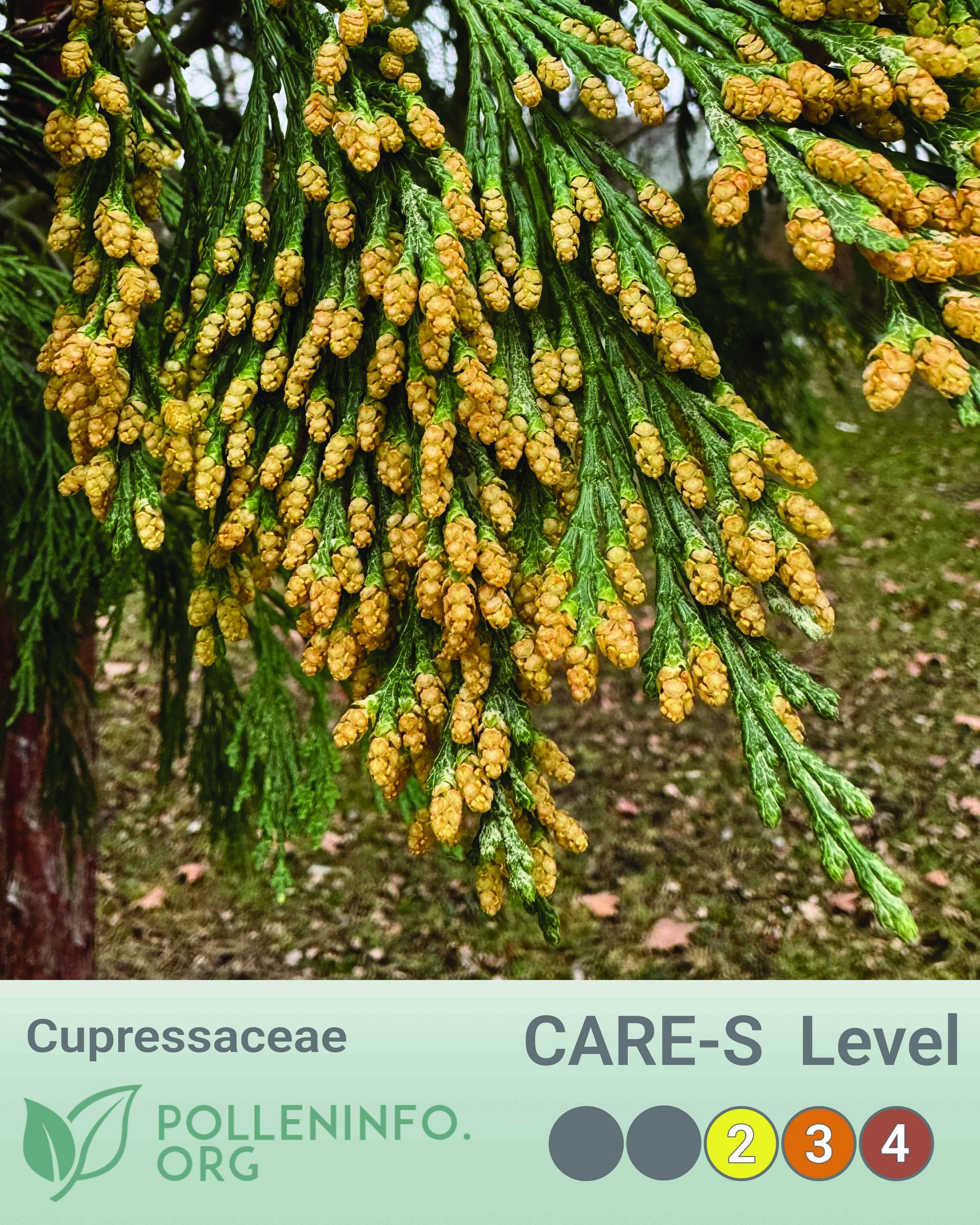
General Information
Family: Cypress family (Cupressaceae)
Flowering period in Central Europe: Early spring to midsummer
Months: 2–7
Allergie Potenzial
CARE-S* Level 2–4. Various allergens e.g., Cry j1, Jun c1.
Cross-reactions
Various allergens have been identified within the cypress family. Due to the structural similarity of these proteins, cross-reactions can occur within the family.
Botanical Information
Distribution
Cypresses are found on every continent except Antarctica.
Morphology
Habit — tree or shrub. Foliage — evergreen needles or scale-like leaves. Reproduction — mostly monoecious, wind-pollinated, high pollen production in male cones; female cones lignify during maturation and contain 1–20 seeds.
Commonly occurring species in Europe
Common juniper (Juniperus communis).
Allergy potential — CARE-S* Level 2 (allergen Jun c1). Habit — Shrub or dwarf shrub. Foliage — Evergreen, prickly needles. Reproduction — Wind-pollinated. Habitats — At forest edges and on rocky slopes, in pastures; also cultivated as an ornamental and useful plant. Flowering in Central Europe — April to July.
Northern white cedar (Thuja occidentalis),Chinese Thuja (Platyladus orientalis).
Habit — Tree. Foliage — Scaly leaves. Reproduction — Wind-pollinated. Locations — Cultivated as an ornamental plant (thuja hedge); Northern white cedar is native to North America, Chinese Thuja is native to East Asia. Flowering in Central Europe — March to May.
Japanese cedar (Cryptomeria japonica).
Allergy potential — CARE-S* Level 4 (allergen Cry j1). Habit — Tree. Foliage — Evergreen needles. Reproduction — Wind-pollinated. Locations — As an ornamental plant or in parks; native to Japan, where it is one of the main allergens. Flowering in Central Europe — February to early April.
* CARE-S is an evidence-based system for categorising the allergenic potential of plants. Additional information about CARE-S is available here.