


Plantcompass
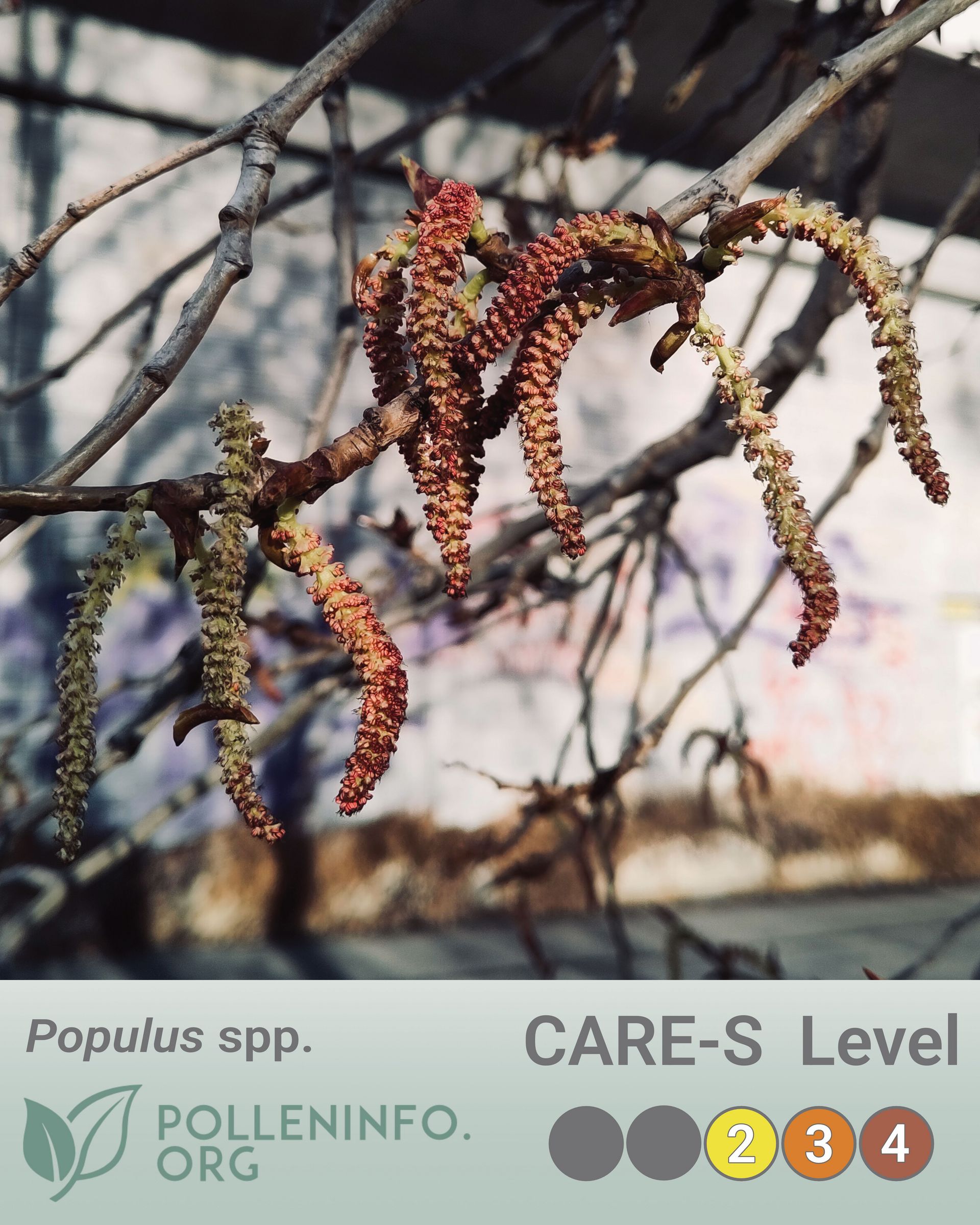
Poplar (Populus spp.)
General Information
Family: Willow family (Salicaceae)
Flowering period in Central Europe: Pre-spring to early spring
Months: 1–4
Allergy potential
CARE-S* Level 2–4. Allergy symptoms are often associated with poplar cotton, even though they are caused by contemporaneous airborne grass pollen. Poplar cotton is indeed consisting of poplar seeds and does not cause allergic symptoms.
Cross-reactions:
Possible cross-reactions with willow pollen due to close familial relatedness.
Botanical Information
Occurrences
Widely distributed on the Northern Hemisphere, naturalized in some countries of the Southern Hemisphere (e.g., Australia, South Africa, Argentina). Habitats — In floodplain and marsh forests, along standing waters and forests. From plains to mountainous areas. Also present in tundra and taiga in the Far North.
Morphology
Habit — Tree or shrub. Foliage — Summer-green, leaves triangular, egg- or heart-shaped, leaf margin lobed or entire, long leaf stalk. Reproduction — Dioecious, ♂ + ♀ catkins, seeds with fluffy hairs (poplar cotton).
Common species in Europe
Black poplar (Populus nigra).
Allergy potential — CARE-S* Level 2. Habit — Tree. Habitats - Marsh and floodplain forests, gravel banks in rivers, pioneer species, cultivated as a park and forestry tree (rapid growth). Flowering period in Central Europe — February to April.
White poplar (Populus alba).
Allergy potential — CARE-S* Level 2. Habit — Tree. Foliage — Summer-green, leaves with white-silvery hairs on the underside (giving the name). Habitats — Marsh and floodplain forests, fallow land, railway embankments, pioneer species. Flowering period in Central Europe — February to April.
* CARE-S is an evidence-based system for categorising the allergenic potential of plants. Additional information about CARE-S is available here.