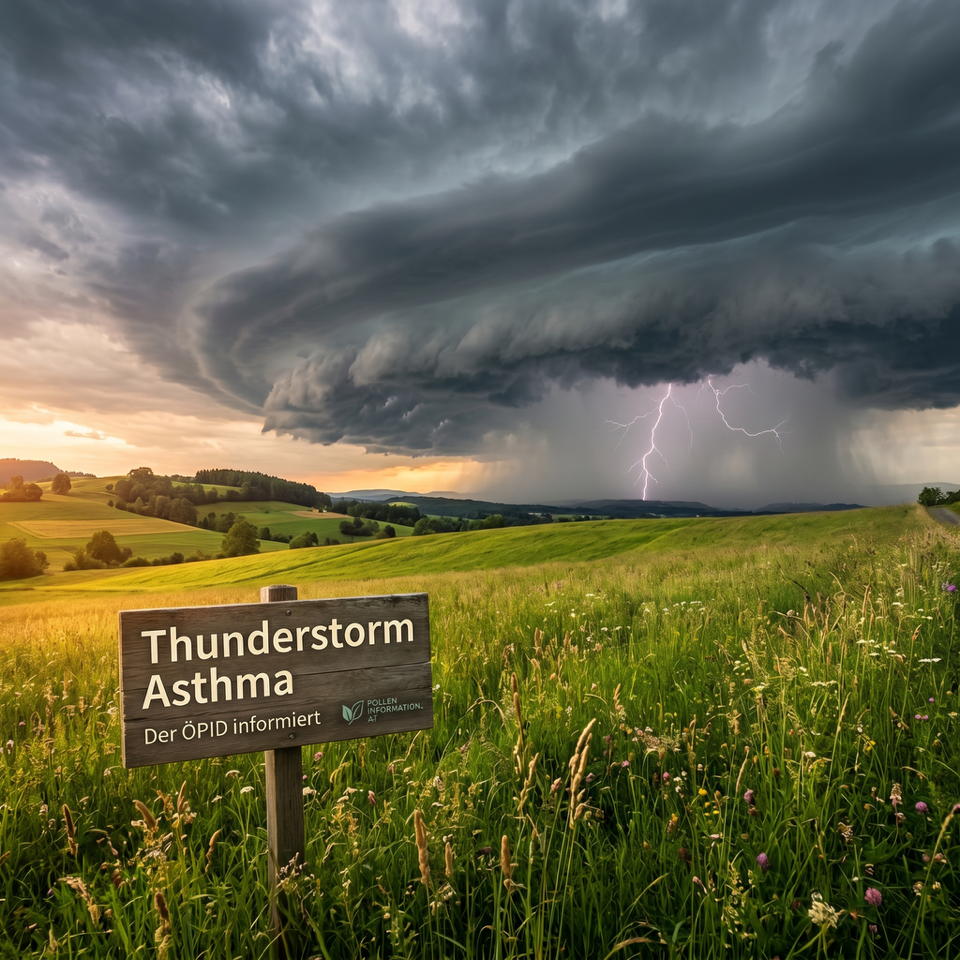


Thunderstorm Asthma – How to protect yourself during thunderstorms and when pollen counts are high
A guide for people with allergies and anyone who wants to get through the pollen season safely.
What is thunderstorm asthma?
When a thunderstorm coincides with high pollen concentrations during the grass flowering season, a rare but serious phenomenon can occur: thunderstorm asthma. This involves a cluster of severe asthma attacks occurring within a short space of time – even in people who had not previously been diagnosed with asthma.
The most severe documented incident to date occurred on 21 November 2016 in Melbourne, Australia. Within a few hours, over 8,900 medical emergencies were recorded there, 9 people died, and a total of 13,689 asthma-related treatments were administered¹⁻². This event has spurred research into thunderstorm asthma worldwide.
Essentially, it involves the interplay of three factors: pollen, thunderstorms and breathlessness.
How does the danger arise?
The mechanism behind thunderstorm asthma can be described in four steps:
- Thunderstorm gusts stir up grass pollen – Strong downdrafts ahead of a thunderstorm sweep pollen from the ground and concentrate it in the air.
- Pollen absorbs water – In the humid air of a thunderstorm, the pollen grains soak up moisture and swell.
- Pollen bursts and releases particles – Osmotic pressure causes the pollen grains to burst. This releases tiny fragments, known as sub-pollen particles.
- Tiny particles penetrate deep into the bronchi – These particles are so small that they can penetrate right into the finest branches of the lungs, where they can trigger inflammatory reactions and asthma attacks.
Recent research also shows that electric fields during thunderstorms can cause pollen to burst. A study from 2026 demonstrates that atmospheric electric charges can significantly accelerate the rupture of ryegrass pollen and the release of sub-pollen particles3.
Who is particularly at risk?
Not everyone is equally susceptible to thunderstorm asthma. Those particularly at risk include:
- People with asthma – they are more susceptible to sudden airway reactions.
- People with a grass pollen allergy – they constitute the most common risk group, even if they have not yet been diagnosed with asthma.
- People with hay fever – even without a known diagnosis of asthma, hay fever can increase the risk, as the allergic inflammation makes the airways more sensitive.
- Children and older people – their airways are more sensitive, so particular caution is required.
People with COPD or other chronic respiratory conditions may also be affected. Studies show that around a third of those affected during the Melbourne incident had not previously been diagnosed with asthma1.
Important note: Anyone who notices asthma-like symptoms such as shortness of breath, coughing or a tightness in the chest during or after a thunderstorm should definitely seek medical advice. Describe to your doctor exactly when and under what circumstances the symptoms occurred. Even if the symptoms occurred only once, this may indicate an underlying allergic predisposition that should be treated.
Protection during thunderstorms – four measures
Simple precautions can significantly reduce the risk.
Stay indoors
As soon as a thunderstorm approaches, close all windows and doors. Your home serves as a safe haven. Further recommendations:
- Set the air conditioning (in the car) to recirculation mode to prevent pollen-laden outside air from entering.
- Only ventilate after the thunderstorm, once the air has been cleansed by the rain.
- Pollen screens on windows are a sensible additional investment.
Use an air purifier
For allergy sufferers, it may be worth investing in an air purifier with a HEPA filter. Modern devices with advanced filter technology are capable not only of removing pollen and fine dust from the air indoors, but – depending on whether they are fitted with an activated carbon filter or special catalysts – also of breaking down ozone, which can occur in higher concentrations during thunderstorms. When buying, look for units that are explicitly suitable for people with allergies and feature a multi-stage filtration system.
Keep medication to hand
Always keep your asthma inhaler and antihistamines to hand – even when you’re out and about, not just at home. In practical terms, this means:
- Use your emergency inhaler as prescribed by your doctor.
- Antihistamines (allergy tablets) can help to alleviate the allergic symptoms.
- Do not change the dose on your own – speak to your doctor first.
- Keeping a small medicine pouch in your bag gives you peace of mind.
Keep an eye on pollen forecasts
Check the pollen forecast regularly – especially on days with thunderstorm warnings. Useful resources:
- Apps: Pollen+, PASYFO with hourly forecasts, or Airmatters.
- Web: Austrian Pollen Information Service
- Be particularly vigilant when: grass pollen levels are high and combined with a thunderstorm forecast
Tip: Enable thunderstorm warnings in your apps so you’re notified in good time, and keep an eye on the weather conditions that can trigger asthma.
With these steps, you’ll be well prepared.
Staying safe through the pollen season
Thunderstorm asthma is rare – but being prepared offers peace of mind. Take these measures to protect yourself and your loved ones:
- Stay indoors → Close windows and doors
- Use modern air purifiers → reduce exposure
- Keep medication to hand → Always carry it with you
- Check pollen forecasts daily → Stay informed in good time
If you have any questions, speak to your doctor or pharmacist. Further information is available from the Austrian Pollen Information Service.
References
1 Thien, F., et al. (2018). The Melbourne epidemic thunderstorm asthma event 2016: an investigation of environmental triggers, effect on health services, and patient risk factors. The Lancet Planetary Health, 2(6), e255–e263.
2 Venkatesan, P. (2022). Epidemic thunderstorm asthma. The Lancet Respiratory Medicine, 10(4), 325–326.
3 Venkatesan, S., et al. (2026). Impact of atmospheric electrical charges on ryegrass pollen rupture and sub-pollen particle release. Scientific Reports.